
America’s most recent, stupid, and criminal war, brought against Iran, at the command of Israel, is only the latest move by the international Zionists.
Their hand lies behind many historical atrocities over the past four hundred years.
That’s why Captain Archibald Maule Ramsay, who served as a Member of Parliament, was held in prison without a trial, or even a charge, for four years, by the criminal called Sir Winston Churchill.
When they let him out, he went back to parliament, and he wrote a book, worth reading, about the conspiracy.
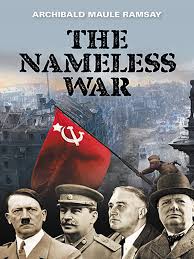
It’s called the nameless war.
=======================================================
Return to my homepage, where you can scroll through more articles, by clicking the site title at the top of the page or at www.fightingmonarch.com
Please retweet or share as many articles as possible.
Our enemy depends on silence.

 Fighting Monarch
I believe your story, but my experience of the Little Prince was not negative. I just thought it was a pretty story. There is no question that the enemy promotes the book, as you say, but I believe your bad experience with it has more to do with the horrible things they did to you in Star City–not with the Little Prince itself. This brings up deep questions, I can tell you, as a professor of English, and a writer, about literary theory–i.e. what does a story mean, and why, and how? How does this relate to the reader, the writer, and the surrounding context? Some things are just corrupt to the core, so a good person could never take over something like a movie about the Joker (which no one should ever watch). But I don’t think this is true of the Little Prince, which could be used for positive purposes. Just a thought….
But, still, you’re right that they want to use certain works to promote loneliness so Catcher in the Rye and Pink Floyd are poison, but then one gets to the rock group of the Police, which I still like, in my own way, even though it comes from a related set of psychological operations.
LikeLiked by 1 person
Absolutely. When I was a boy, and before, there were Christians who said that rock and roll was the devil’s music. I am not a Christian, and, at the time, I thought these critiques were ridiculous and ignorant. Later, however, I came to see that rock and roll was a psychological operation designed by devil-worshippers to turn children toward illegal drugs, promiscuous sex, and disassociation (phasing out). So, I wrote in my second book about one of my friend’s fathers who was a world famous independent film maker, as he made documentaries about not only the ocean, and China, and Yale but also Bob Dylan (whom he filmed the first time Dylan played electric) and The Who, Jimi Hendrix, and the Doors who played at the Isle of Wight (where British Military Intelligence tried to start a controlled riot so they could round people up).
Anyway, here’s my article on the Isle of Wight, with pictures of my friend’s dad (where I took an overly friendly view of Joni Mitchell).
Here’s my article on CIA creating controlled riots, while they recently declassified material where they admitted to this.
And here’s the bit from my second book, Playboy’s Progress, which anyone can download and share for free at this site.
“Noah Lerner was my other room-mate, and we both benefitted from Monica’s advice on classes. I enjoyed talking about books with him, when we weren’t partying.
“Noah’s father, Murray, was a genius, a real intellectual, who, in his eighties, told an interviewer he was still learning. This man studied poetry at Harvard before he became a director famous for his documentaries. He taught film at Yale, and he made To Be A Man to document its student life.
“Murray Lerner hung out with folk, jazz, classical, and rock stars in the 1960s. At Newport, he filmed Bob Dylan, Joan Baez, Buffy Sainte-Marie, Judy Collins, Pete Seeger, Donovan, Johnny Cash, Hobart Smith, the Georgia Sea Island Singers, Odetta, Brownie McGhee, Howlin’ Wolf, Son House, and Mississippi John Hurt for his documentary, Festival, which was nominated for an Oscar. Later he used outtakes for his documentary on Bob Dylan, The Other Side of the Mirror. Using footage from his work at the Isle of Wight, Professor Lerner made Message to Love as well as more specific films about the Who, Jimi Hendrix, Miles Davis, Joni Mitchell, Leonard Cohen, Jethro Tull, the Doors, the Moody Blues, and Emerson, Lake, and Palmer.
“Professor Lerner caught three major historical moments on film: the Newport Festival where Bob Dylan went electric, the Isle of Wight Festival where the Doors and Jimi Hendrix made their last appearances, and Isaac Stern’s trip to China.
“Although I have no doubt that Tavistock Institute used, brainwashed, and influenced my friend’s father, Professor Lerner saw himself correctly as an artist, thinker, and historian. As he said of his work,
‘I think I have a feeling for what is happening and what is going to happen, and I move towards that moment.
‘And it’s often proved to be right, but there are many other such moments that I haven’t been at but I’ve been to moments that were important like those two festivals.
‘Isaac Stern in China was another moment. That was actually a big opening in the culture of China.
‘But the other part of it is, maybe I’m being egotistical, but, to be honest, I’m making it that moment. I’m describing it in a way that makes it a moment. Not everyone going to China would describe it that way. Not everyone going to the Isle of Wight would do that. Not everyone going Newport would do that either. It’s a question of taking what’s happening and making something out of it that makes it a historical moment.’
“Professor Lerner’s approach to history through film was expressionistic and creative in a way that, to me, recalls Nietzsche.
‘I’m portraying what I feel, which is different from just recording a concert. So the difference in that sense is I bring to it my feelings and the photography and the editing. I create a piece of work that shows my feelings.’
“This artist was true to his subject matter, and he recorded it accurately; but it was never just a matter of turning the camera on and letting it run. In his own words, Professor Lerner used history to create ideas.
“When people learned his father was a film director, they would sometimes say to Noah, condescendingly, ‘Maybe some day he’ll win an Academy Award.’ Then Noah would be forced to tell them that he already had one. Professor Lerner had won an Oscar for his documentary on Isaac Stern’s trip to the People’s Republic of China, From Mao To Mozart. He did not regard his Academy Award as important, saying,
‘People worship these awards.
‘It’s good publicity, but that’s all I think about it.’
“That award may have held most importance because it helped move Noah to Pomona College. When his father accepted the prize, Richard Chamberlain, a Pomona alumnus, served as presenter. My friend denies it, but I believe that somehow this must have factored into Noah’s decision to attend our school.
“From Mao to Mozart portrayed the famous violinist and music teacher, Isaac Stern, as the first American musician to collaborate with what became the China National Symphony Orchestra. During his trip to the People’s Republic, Stern lectured before the Central Conservatory of Music and the Shanghai Conservatory of Music. This was a groundbreaking development since less than ten years earlier, when Mao forbade western music, during the atrocities of the Cultural Revolution, a conductor was imprisoned for playing Beethoven.
“Noah’s dad reached out to young audiences throughout his life. He began his career with Secrets of the Reef, which was later divided into thirteen half-hour productions called Wonders of the Sea and distributed for years to schools and media within the United States. I would imagine this early documentary may have had some influence on Jacques Cousteau. Later my friend’s father made Magic Journeys as a 3-D short to depict the world through a child’s eyes. This was the first 3-D picture to feature computer-generated animation, which has been shown for years at Disney theme parks.
“The collaboration with Disney, like the promotion of China, was not the only evidence of programming in Professor Lerner’s work.
“In creating The Other Side of the Mirror, about Bob Dylan at Newport, the famous director made an obvious reference to Through the Looking Glass, which figures large in MK-ULTRA, as he spoke of the need to pass into a different world, through the glass, in order to appreciate the film. Alice in Wonderland always shows programming.
“Even worse, my friend’s father spoke not only of technology but also of hypnotism, mesmerism, trances, splitting, gateways, new worlds, and dissociation as he described the sixties scene he experienced close-up and firsthand when he worked and partied with the Ayatollahs of Rock and Roll-a.
‘I felt that electricity was needed to distribute the music on a wide basis, radio and television.
‘Then once it happened, the hunger for the feeling that electricity gave people listening to it was more than volume.
‘I think electric music gets into your body and enters into your nerves quite deeply–almost puts you into a trance.
‘It’s hypnotic.
‘I’ve always felt this and that was the feeling I had when I watched Bob [Dylan].
‘And I was excited by it. I not only appreciated the changes: I loved it!
‘I really was mesmerized and hypnotized by “Maggie’s Farm” and “Like A Rolling Stone” on many levels. I was both in the pit and on the stage as I was filming it.
‘I knew it was a gateway to a new culture…and I thought this was it.
‘I was mesmerized by electric music, and when Dylan went electric it got into your bones.’
“Wow! That statement applies not only to Dylan but to the electric effects of the counterculture’s chosen art form. Like his son, Murray Lerner combined a strong and healthy physical nature, deeply anti-intellectual, and enormously fun, with a brilliant analytical mind. Unfortunately, our enemies knew how to turn these qualities against us, as we dissociated. When you’re hypnotized, you’re under someone else’s power. Thus I begin to see my friend’s father not merely as Zarathustra but as the superman in the thrall of the magician.
‘ONLY FOOL! ONLY POET!’
“Bob Dylan, like so many, shows heavy signs of mind control, from his attack on the John Birch Society, to his introduction of marijuana to the Beatles, to his bizarre behavior throughout his life, to the motorcycle crash on the eve of Lammas. The Illuminati love to stage accidents, they love to implant people, and they often switch one person for another. They did it with Peter the Great. They made Paul Faul. And they did something with Bob Dylan. Whatever accounts for the change, the man who came out of the hospital was not the man who went in.
“Certainly, Dylan’s iconoclastic switch to electric amplification at Newport bespoke programming. Dylan took the stage, and was paid, with the understanding that he would play acoustic music. Instead he played the disruptive child. Rather than speak to the organizers ahead of time, as a man would have done if he wanted to challenge the ethos of the festival and the expectations of the audience, Dylan decided on a whim to play with a fully amplified band. He showed up under the influence of drugs, and his performance was unprofessional. He didn’t even bring the right harmonica on stage, so he had to ask the audience for an E-model. The sound quality of the bard’s electric debut was terrible. You’d think if he wanted to surprize the audience with a new form of music, he would want it to sound good. No wonder Dylan did not return to the Newport Festival for thirty-seven years; and, when he did, the Tamborine Man, for reasons known only to himself, wore a fake beard and a wig. Through his bizarre mind-controlled antics, Dylan’s programmers threw a wrench into the works of a well-functioning American institution, damaging years of goodwill carefully built up among the organizers, the artists, and the audience. What was attendance the following year?
“People booed Dylan, but no one knows who or why. They’re still debating it. Professor Lerner noted the odd reaction of the audience.
“When Noah’s father showed his film, The Other Side of the Mirror: Bob Dylan at the Newport Folk Festival, at The New York Film Festival, one person stood up and said, ‘About this booing…I was sitting right in front of the stage. There was no booing in the audience whatsoever. There was booing from the performers.’
“Professor Lerner, who had filmed the performance, replied, ‘Well, I don’t think you’re right.’
“Then another person stood up and said, ‘I was a little further back and it was the press section that was booing, not the audience.’
“Professor Lerner, who had worked with his memories, film, and mind for months to make the motion picture, replied again, ‘Well, I don’t think you’re right.’
“Then a third guy stood up and said, ‘I was there, and there was no question: It was the audience that was booing and there was no booing from the stage.’
“As the film-maker summed up reactions to Dylan’s performance, ‘It was fascinating. People remember hearing what they thought they should hear.’
“This seems a classic example of mind control. In my childhood gift from Lara Smith, Stories from around the World, “The Emperor’s New Clothes” concerned people’s inability either to see reality or to admit they saw reality. Instead, they shaped their answers to fit an existing paradigm. They said they saw what they thought an intelligent person would see. Here it was the same thing. Some had the idea that only the press should boo, others felt that only performers should boo, and a third group insisted that the hostile reaction arose entirely from the audience. How probable is that? Of course, there must have been boos from each of the three segments.
“The mind control boys still use Bob Dylan’s immature antics to turn people against each other. How could this be important to anyone? Who cares who booed fifty-five years ago? A lot of people do, and they feel strongly about this idiotic subject. No wonder Dylan is a favorite of the New World Order. He’s still doing their work, as he makes people fight over stupid things.
“Unlike his subject, Bob Dylan, Professor Lerner viewed the relationships among artists, film-makers, and audiences as collaborative. As he once said, ‘I become part of the band when I film a band.’ He attributed a similar rôle to the audience. His attitude reminds me of the South African concept of ubuntu in which people exist not in themselves but in relationships with others.
“The Who was one of my room-mate’s father’s favorite bands because they had a sense of their relationships with their listeners. As Professor Lerner observed,
‘They connect with the audience in a way very few groups do because the audience is part of their concert.
‘Pete Townshend thinks of them being part of the audience and the audience being part of them….
‘They recognize that that’s what’s happening. A lot of groups don’t.
‘I think there’s always a connection but a lot of groups don’t understand it.’
“Murray Lerner appreciated Pete Townshend’s ability not only to connect with the audience but to have awareness of himself, others, and the event both as individual parts and as a whole. It is easy for me to imagine how, as fellow intellectuals, the two men could relate to each other.
“Still, I see the terrible danger in Murray’s Dionysian approach to music, as in the Who’s. Let’s not forget this band got into fistfights with each other, and their drummer killed himself through lack of self control. As brilliant as he was, in an Apollonian capacity, capable of hard work and sharp analysis, Noah’s father liked to lose himself in the performance, in the moment, just as Noah and I lost ourselves in revelry. There was an aspect of dissociation in his approach. As he said, ‘My thought about filming music, or filming anything that has sound or motion, has always been that you have to put yourself into it and then forget yourself.’ Isn’t that the point of sex, drugs, and rock and roll?” (Playboy’s Progress, pp.84-94)
LikeLiked by 1 person
When I was a boy, in the 1970s, the enemy was much smarter than today, so they wanted us to peace out to music.
They wanted us to be peaceful, so we would not fight them in politics–although we always fought them in other ways.
So, for healing music, I would recommend “AM GOLD” from the 1970s.
I gave Paul McCartney and the Wings to my daughter.
It’s what I grew up with, and it never hurt me even a little bit.
Plus, you and I know how to change the station, if something hits us wrong.
The biggest thing, I would say, is that this music is meant for us to listen on the radio or the phonograph (record player).
We should not watch the musicians or videos.
As I used to say to my daughter, all we need is a little luck….
She was the woman that I always dreamed of.
She was with me right down the line.
Anyway, that’s what I grew up with, and it’s totally cool if you don’t like it, and it doesn’t speak to you.
There is certainly other easy listening music….
LikeLiked by 1 person
Here, too, is one of my fight songs with an accompanying story from my first book!
LikeLike
And I also wanted to give you George Harrison, who told people, “think for yourself.”
He learned from Ravi Shankar, the Brahmin, whom my friend’s father also knew, while he wrote about people who would never understand.
And he wrote songs around the Tao te Ching.
And he wrote songs to Krishna.
They were true prayers.
But, of course, like any real human, he made a lot of mistakes, and it’s totally cool if you don’t like this stuff.
Something really neat that he did, while he was raised a Roman Catholic, and became a Hindu, was to finance, risking everything he owned, a movie that made fun of Christianity.
It’s a silly film called “Life of Brian,” which was banned by their Pope!
LikeLike
Sorry to write and write, but for what it’s worth, I would also recommend Crosby, Stills, and Nash, who are very peaceful.
And I strongly believe in the emotional intelligence of symphonies, and concertos, which are also enemy products, but they will take us each through ups and downs, while they always leave us with ups.
This means Rachmaninoff.
This means Beethoven.
This means Brahms.
And it means so many other things, while the idiots expect us to listen to them as they interrupt our music with advertisements!
LikeLike
A simple farmer is a very good thing to be! The good bloodstock of your family shows in your strength and your fight. As we say in English, it’s “what’s bred in the bone.”
LikeLiked by 1 person
I had a schoolmate whose surname was romanov and had russian ancestry.
The little prince tames a rose (no comments hahahaha), but really frightening was Tistou the boy with green thumbs, which was as popular as the little prince in Brazil (both curiously french)
Rockn roll and its derived styles (hard rock, heavy metal etc) was the first experiment music to be created in MK labs. All their famous artists are programmed with stuff like alice in wonderland, freedom train (death) and Frank baum material.
B3atl3s and Bl4ck S4bb4th were heavily used in me and I got myself rid of the first ones but BS still haunts me I listen to that time and again and see the vocalist’s name: 0zzy…
0zzy’5 d4ught3r tatt00:
(“This t00 sh4ll p4ss”)
Be’s metal glove..
Robot promotion and MK: Small wonder became a hit but was produced with veey low budget and no shown in any big channel, critics despised it and the public loved it (including here), guess why..
LikeLiked by 1 person
As to your Romanov classmate, it’s interesting how many Russian and German refugees ended up in Latin America.
LikeLike
Rock’n roll and its branches= music style from nowhere artificially produced in labs for the post war era
Post war sport linked to rockn roll since the beginning: surf.
It even had its own music style, “surf music”.
The peak of the sport for the general public: when the ph4llic surfboard enters the tube… hmm more r0s3 cult..
Surf was forged. It is not a hawaiian thing. The hawaiian pastime was different. Surf is about a ph4lu5 entering a hole.
LikeLike
Pictures of Di0g0 J0ta (p0rtugu3se pl4yer who was k1ll3d in a car acc1dent yesterday) celebrating g0als:
.
.
.
.
LikeLiked by 1 person